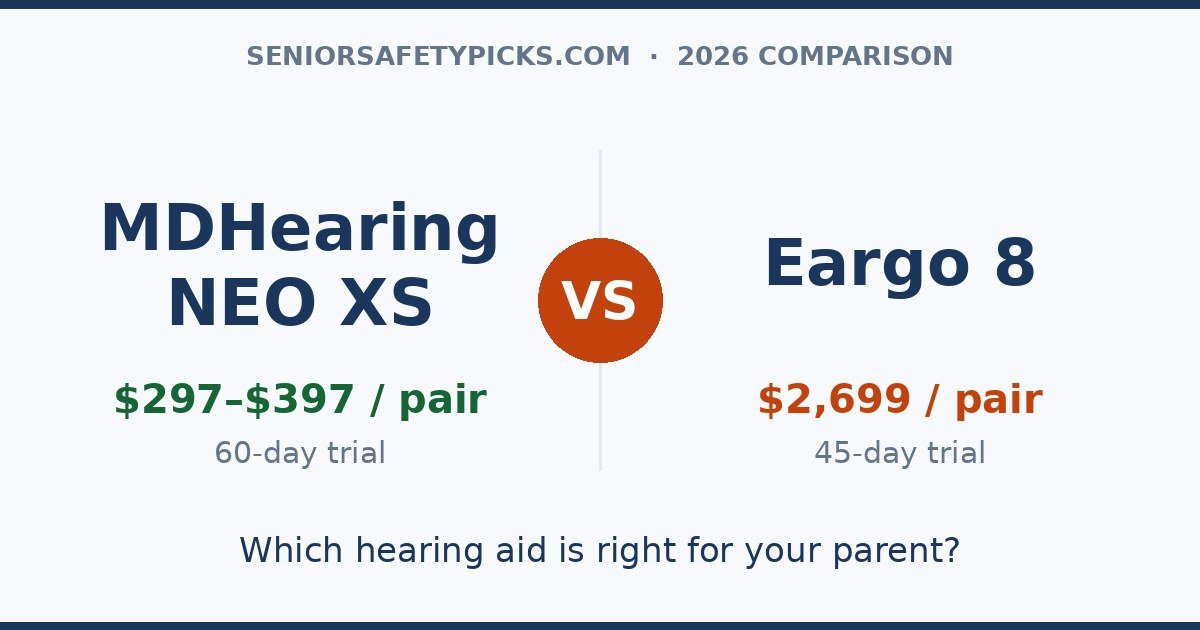
Short on time? Here’s the honest answer: for most seniors with mild to moderate hearing loss, the MDHearing NEO XS is the smarter buy at $297–$397 a pair — it does the essential job for a fraction of the price. The Eargo 8, at $2,699, is a more polished device: it adjusts itself automatically, is nearly invisible, and carries a two-year warranty. If budget is tight, get the NEO XS. If your parent wants the most comfortable, most discreet option and the price doesn’t scare you, the Eargo 8 is worth a look — with one honest caveat about noisy rooms we cover below.
Disclosure: This article contains affiliate links. If you buy through them, we may earn a commission at no extra cost to you. We only recommend products we’ve researched thoroughly.
New to over-the-counter hearing aids? Start with our full guide to the best OTC hearing aids for seniors under $500 — it explains how OTC devices work and who they’re for.
Quick Comparison
| MDHearing NEO XS | Eargo 8 | Eargo SE (budget Eargo) | |
| Price (pair) | $297–$397 | $2,699 list; sales common | $1,699 list; sales common |
| Style | In-the-canal, nearly invisible | Completely-in-canal, invisible | Completely-in-canal, invisible |
| Rechargeable | Yes, charging case | Yes, case holds 14 recharges | Yes, charging case |
| App control | No (PRO version has app) | Yes + automatic Smart Sound Adjust | Yes, no auto adjust |
| Bluetooth streaming | No | No | No |
| Water/dust rating | Not specified | IP68 | IP54 |
| Trial period | 60 days | 45 days | 45 days |
| Warranty | 1 year | 2 years | 1 year |
| Best for | Budget-first buyers | Comfort and effortless use | Eargo comfort, lower price |
Prices checked July 22, 2026 on manufacturer and expert-review sites. Both brands run promotions often — the price you see today may be lower, so always check before deciding.
MDHearing NEO XS Review: Best Value
MDHearing has been selling doctor-designed, budget hearing aids since 2009, and the NEO XS is its smallest model yet. It sits inside the ear canal, so from the side it’s almost impossible to spot. The charging case works like a wireless earbud case: drop the aids in overnight and they’re ready in the morning. There are no tiny batteries to fumble with — a real advantage for anyone with arthritis or shaky hands.
Sound-wise, the NEO XS covers the common pattern of age-related hearing loss: it boosts speech frequencies so conversations and TV dialogue come through clearer. It has preset listening programs you switch with a small button on the device. What it does not have is smartphone app control — the base NEO XS is deliberately simple. MDHearing sells a NEO XS PRO version with app-based personalization if your parent wants fine-tuning.
The trial period is 60 days — longer than Eargo’s 45 — and MDHearing includes lifetime access to its audiologist support team by phone. The warranty is one year.
What we like
- Price: at $297–$397 a pair, it costs about one-seventh of an Eargo 8.
- Truly small and discreet for this price range.
- Simple to use — no smartphone or app needed at all.
- 60-day risk-free trial, the longest in this comparison.
- Lifetime phone support from hearing specialists included.
What we don’t like
- No app on the base model: all adjustments happen through one small button, which can frustrate users with limited dexterity.
- Background-noise handling is basic. In a loud restaurant it will amplify more noise than a premium device.
- Some customer reviews report slow or difficult refund processing, so keep your trial paperwork and dates.
- One-year warranty is half of what Eargo 8 offers.
Eargo 8 Review: Best Comfort and Convenience
Eargo built its reputation on one idea: hearing aids people actually want to wear. The Eargo 8 is its newest flagship, a completely-in-canal device suspended on soft petal-shaped tips that let air flow through the ear. Most wearers describe it as barely noticeable, both to themselves and to everyone else.
The headline feature is Smart Sound Adjust: the Eargo 8 listens to your environment and switches settings automatically. Your parent walks from a quiet kitchen into a busy café and the device adapts on its own — no button, no app fiddling. For a senior who “doesn’t want to deal with technology,” automation like this is useful every single day. Initial setup and personalization happen through the Eargo smartphone app, so someone in the family should be comfortable installing it and completing the in-app hearing check. After setup, the aids largely run themselves.
Battery life is a real strength: up to 16 hours per charge, with a charging case that holds 14 full recharges — about two weeks of use before the case itself needs power. Eargo 8 also carries an IP68 rating (strong dust and moisture resistance), a two-year warranty, a 45-day trial, and lifetime remote support from Eargo’s hearing professionals.
Now the honest caveat. Independent lab testing by HearAdvisor scored the Eargo 8’s speech-in-noise performance well below the category average — among the weakest results of the products they’ve measured. In plain terms: you are paying $2,699 for comfort, invisibility, automation, and support, not for standout performance in a loud restaurant. For quiet homes, one-on-one conversation, and TV, wearers are generally happy; for frequent noisy gatherings, temper your expectations — or test it hard during the 45-day trial.
What we like
- Smart Sound Adjust means zero daily fiddling — the device adapts itself.
- The most invisible and, by most accounts, the most comfortable fit in the OTC market.
- Class-leading battery system: 16 hours per charge, two weeks per case.
- IP68 rating and a two-year warranty — the best durability package here.
- Lifetime remote support from licensed hearing professionals.
What we don’t like
- Price: $2,699 a pair is roughly seven times the cost of the NEO XS.
- Independent lab tests (HearAdvisor) rate its speech-in-noise performance well below average for its class.
- No Bluetooth audio streaming — it won’t stream calls or TV sound like some rivals.
- Completely-in-canal design doesn’t suit everyone — heavy earwax producers or very narrow ear canals can have problems.
- Setup requires a smartphone and the Eargo app; the trial is 15 days shorter than MDHearing’s.
The Middle Option: Eargo SE
If you like Eargo’s invisible fit but not the flagship price, the Eargo SE is the same comfort concept without Smart Sound Adjust, with a lower IP54 rating and a one-year warranty. At $1,699 list (often discounted), it sits awkwardly in the middle: still four times the price of the NEO XS, without the Eargo 8’s standout automation. We’d pick it only if in-canal comfort is the deciding factor and the Eargo 8 is out of budget.
Head-to-Head: Which One Wins Where
Price and value — MDHearing wins
This isn’t close. You could buy a NEO XS pair, replace it every two years for a decade, and still spend less than one pair of Eargo 8s. For mild to moderate loss on a limited budget, the NEO XS is the rational choice.
Sound — closer than the price suggests
The NEO XS amplifies speech well in quiet and moderate settings and struggles in loud ones — expected at $397. The surprise is that the Eargo 8, per independent lab measurements, also underperforms in noise relative to its class. Its everyday sound is pleasant and its automation is convenient, but a seven-times-higher price does not buy seven-times-better hearing in a crowded restaurant. If noisy family dinners are the main problem you’re solving, neither of these is a magic fix — use the trial periods ruthlessly.
Ease of use for seniors — depends on the senior
For a parent who refuses smartphones entirely: the NEO XS, because it never needs one. For a parent with a smartphone (or family nearby for the one-time setup): the Eargo 8, because after day one it adjusts itself and there’s nothing to press.
Trial, warranty, and support — split decision
MDHearing gives you 15 more trial days (60 vs 45). Eargo gives you double the warranty (2 years vs 1) and stronger water resistance. Both include lifetime professional support at no charge, which is rare and valuable in this market.
How We Chose
We compared current manufacturer pricing (checked July 22, 2026), published specifications, independent lab measurements from HearAdvisor, expert reviews, and verified customer feedback, weighing the criteria that matter most for older adults: ease of daily use, rechargeability, trial and warranty terms, real out-the-door cost, and performance in the situations seniors mention most — TV, phone calls, and noisy family meals. We don’t accept free units from manufacturers, and our recommendations are not influenced by commissions.
Frequently Asked Questions
Is the Eargo 8 really worth $2,300 more than the NEO XS?
Only if the extras matter to your parent: automatic adjustment, near-invisibility, two-week battery case, and a two-year warranty. Independent lab data suggests its advantage in noisy rooms is smaller than the price gap implies. If your parent mostly watches TV at home and talks one-on-one, the NEO XS delivers most of the everyday benefit for a fraction of the money.
Do either of these work for severe hearing loss?
No. Both are FDA-regulated OTC devices intended for adults with mild to moderate hearing loss. If your parent struggles to hear even with amplification, or the loss came on suddenly, book an appointment with a hearing professional before buying anything.
Which one is better for a parent who hates technology?
The NEO XS never touches a phone, so it wins for total technology avoiders. But note the twist: after someone completes the app setup for them, the Eargo 8 actually requires less daily interaction, because it adjusts itself.
Can I return them if they don’t help?
Yes — MDHearing gives 60 days and Eargo 45 days, both risk-free. Mark the deadline on a calendar the day the box arrives, keep the packaging, and start the return well before the window closes. A few MDHearing customers report slow refunds, so keep records of everything.
Will Medicare pay for either of these?
Original Medicare does not cover OTC hearing aids. Some Medicare Advantage plans offer a hearing allowance that may apply — check your parent’s specific plan documents before assuming coverage.
The Bottom Line
The MDHearing NEO XS and the Eargo 8 aren’t really fighting for the same buyer. The NEO XS is the best answer to “my parent needs help hearing and we don’t want to spend thousands” — simple, rechargeable, discreet, and protected by the longest trial here. The Eargo 8 is the best answer to “we want the most comfortable, most effortless device on the market” — just go in knowing that its lab-measured performance in noise doesn’t match its price tag, and let the 45-day trial be the judge.
Our advice: start from the budget, not the brochure. If $400 is the ceiling, order the MDHearing NEO XS and use all 60 days to test it in real life. If comfort and effortless everyday use justify a premium, try the Eargo 8 — and test it hard in the exact situations your parent finds difficult. Either way, your parent hears the grandkids again. That’s the point.